
‘There are no rules against crying in the archive,’ Professor Kim F. Hall said in her magnificent keynote at this year’s SAA meeting. She was discussing her work with the records of early Americans, and the lives of enslaved people who appear in that archive only as items bought and sold. Hall described how painful it is to try to extrapolate a life from that kind of record, where so little humanity has been afforded to them.
I have been spending time in a very different kind of archive, one which possibly affords too much humanity to its subjects. Can we have too much empathy for people from the past? In this case, the people in question are members of the royal family; their archive at Windsor Castle preserves their lives in great detail (though their holdings are not, admittedly, meticulously catalogued). It holds personal letters to family members; political letters to members of the government; receipts for purchases; diaries and journals; schoolwork, sketches; scraps. Nothing that might shed light on some aspect of these people has been thrown away.
It’s very seductive, this wealth of material. It’s easy to be taken in by the rich quantity of papers and forget that the privilege which led to these lives being archived in such loving detail is a privilege derived from the sale of black lives like the one Hall was searching for, a boy bought and sold.
I need to remember this, because I am sometimes at risk of being charmed by them. There are no rules against crying in the archive, but what does it say about me that I sometimes want to cry for Queen Victoria?
The project that occasions this, ‘Shakespeare in the Royal Collections,’ is an exciting one: we want to unpick the mutually dependent histories of Shakespeare and the royal family; how those two hegemonic institutions lean on one another; how the royals have used Shakespeare to re-organise history to their advantage and how the prestige associated with royal patronage has helped to cement Shakespeare’s canonicity. I believe in this project, but I won’t pretend that it isn’t sometimes hard to talk about. I am vain enough to worry, when I don’t have time to do a full spiel, that my little conference bio makes me sound like a royalist.
The structure of the archive in some ways works against what the project sets out to do. Our research questions want to speak to the monarchy as an institution, but the archive has biographers in mind: organising its material almost entirely around names and reigns, it invites users to privilege individuality and humanity. And while I’m finding that royal individuals have sometimes used Shakespeare strategically to construct their public personae, a lot of the Shakespeare-related material is much more personal and more human. They quote Shakespeare to one another; they describe performances they enjoyed or were disappointed by. Shakespeare belongs to leisure time; when we look for Shakespeare in the royal archives, we find the royals at their most trivial, and perhaps also their most intimate.
Sometimes the royals make it easy not to like them too much. In passing, they mention their relief that rebellion in India has been brutally suppressed. Hundreds of thousands killed by British soldiers linger, invisible, behind their brief, euphemistic remarks about the ‘good news from India.’ On a more quotidian level, they express their irritation when drives in the country are disrupted by beggars. They are casually xenophobic and anti-Semitic. Not more so, necessarily, than many of their white British contemporaries, but strikingly so to a modern reader.
Still, the trivial humanity in the archive can be seductive. I was amused to discover, in a volume of letters from Prince Albert to his eldest daughter, that he called his mother-in-law “Mama Kent” (that’s Princess Victoria of Saxe-Coburg Saalfeld, the Duchess of Kent, to you and me). He seems to be wryly acknowledging stereotype when he tells Vicky that his new librarian is a man of ‘intelligence and —wonderful for an Englishman—of system!’ His letters often include detailed, delighted accounts of baby Princess Beatrice’s antics. History remembers Albert as cold, exacting, and manipulative, but what warmth he had is preserved in the archive.
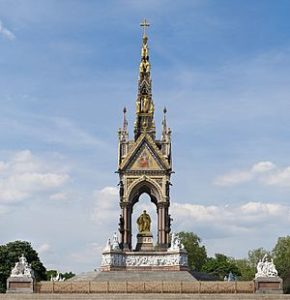
Because Shakespeare belongs to leisure time — theatregoing, private theatricals, buying and commissioning art, and so on — there are gaps in the archive where these pursuits were suspended. Albert died in December 1861, leaving Victoria widowed for the last forty years of her reign; leaving nine children, the youngest, Beatrice, four years old. He was forty-two. Volumes of playbills — volumes of amateur artwork — volumes of letters — records of frivolous purchases like art, gifts, jewellery — all these are left with blank pages by Albert’s death. There are no rules against crying in the archive, and those blank pages speak poignantly of the family life that was broken by loss. The extravagance of Victoria’s grief is written across London; the Albert Memorial in Kensington Gardens makes her emotion spectacular, imperialistic, and a little absurd, but the blank pages in the archive make it human.
I want to resist the royal archives’ temptations towards reading for humanity, because I worry that it is uncritical, and that the royals’ individual personalities are a distraction from more urgent questions about the politics and ideology served by Shakespeare for the monarchy as an institution. But I also want my scholarship to be humane, and it’s clear to me that humanity is part of the story: Shakespeare is as often a tool of intimacy as a tool of politics.
There are no rules against crying in the archive, but I need to ask why the archive is conspiring to make me cry, and what is missing from a story that gives its subjects such abundant humanity.